
The Art of Layering: How to Mix Color, Texture and Pattern with Confidence
Some interiors are beautiful at first glance. Others invite you to keep looking.
The difference is often layering.
A thoughtfully layered room reveals itself gradually—the texture of a fabric, the grain of wood, a subtle pattern in a rug, an unexpected piece of art, the patina of something collected over time.
These details give a home depth and personality.
But layering is also one of the more nuanced aspects of interior design. Too little, and a room can feel flat or overly coordinated. Too much, and it can become visually overwhelming.
The goal isn’t to add more.
It is to understand what to combine, what to repeat and where to create quiet.
Begin With a Point of View
Before selecting individual fabrics or colors, it helps to establish how you want the room to feel.
Warm and enveloping? Light and serene? Tailored and sophisticated? Collected and worldly?
That overall feeling becomes the filter through which every subsequent decision is made.
A successful room doesn’t need every element to match, but the elements should feel as though they belong to the same conversation.
Build a Palette Rather Than Choosing a Single Color
Color is most interesting when it isn’t treated as an isolated decision.
Instead of selecting one “accent color,” consider creating a broader palette with varying degrees of intensity.
A warm neutral may establish the foundation. A deeper tone can add weight. A quieter secondary color might appear in textiles, artwork or accessories.
Not every color needs to appear in equal amounts.
In fact, restraint often makes the stronger colors more powerful.
And neutral interiors still need variation. Ivory, sand, camel, taupe and warm gray can create tremendous richness when their undertones and textures are carefully balanced.
Texture Can Be as Important as Color
When a room feels flat, the solution isn’t always more color.
Often, it needs more texture.
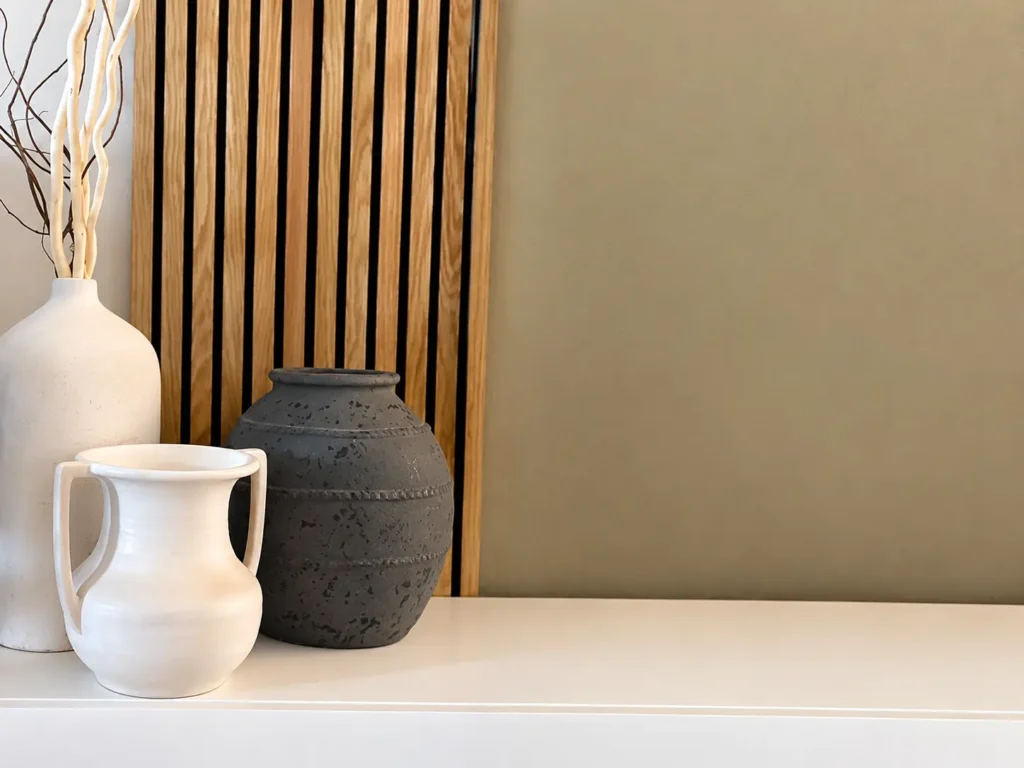
Linen, velvet, wool, bouclé, leather, wood, stone, metal, plaster and woven materials all interact with light differently. Combining them creates subtle contrast even within a restrained palette.
Imagine a room composed primarily of warm neutrals.
A linen sofa, wool rug, veined stone table, aged brass fixture and handwoven textile may share similar colors, yet each contributes something different.
That is what gives a quiet interior dimension.
Vary the Scale of Pattern
One of the secrets to mixing patterns successfully is avoiding too many patterns of the same scale.
A large organic or botanical motif can coexist beautifully with a smaller geometric pattern, a subtle stripe or a textured solid.
When every pattern is equally bold, they compete.
When their scales vary, the eye has somewhere to rest.
Color can also create continuity. Patterns don’t have to match, but repeating one or two tones across different textiles can make the combination feel intentional.
Give the Eye Somewhere to Rest
Layering requires restraint.
If the rug is expressive, the upholstery may need to be quieter. If the drapery carries a strong pattern, nearby pieces might provide visual relief.
This balance between statement and restraint is what allows individual elements to be appreciated.
Negative space is part of layering too.
Not every wall needs art. Not every surface needs an accessory. Not every chair needs a patterned pillow.
Knowing when to stop is just as important as knowing what to add.
Mix Old and New
Rooms become particularly interesting when everything doesn’t come from the same moment in time.
An antique chest can bring warmth to contemporary architecture. A vintage rug can soften clean-lined furniture. Modern artwork can completely change the feeling of a traditional room.
Collected pieces—whether inherited, discovered while traveling or simply loved for years—give a home a sense of history.
We don’t believe meaningful pieces need to be removed in order to create a sophisticated interior.
Often, they are exactly what prevents a room from feeling generic.
Repeat Without Matching
Repetition creates rhythm.
A tone from a rug might reappear subtly in a pillow. A dark metal used in lighting might be echoed in a furniture detail. A curved form might appear again in a chair, mirror or sculptural object.
These connections don’t have to be obvious.
In fact, the most sophisticated rooms rarely announce why everything works together.
They simply feel resolved.
Let One Element Be Unexpected
A room becomes memorable when something interrupts predictability.
It might be contemporary art in a traditional setting, an unusually shaped chair, a saturated textile in an otherwise quiet palette or an object from another culture or period.
The unexpected element doesn’t need to dominate the room.
It simply gives the composition personality.
A Layered Home Evolves
Perhaps the most important thing to remember is that a beautifully layered home does not have to look as though everything was purchased at once.
Homes become more interesting when there is room for evolution.
At Avantte Interior Designs, we use color, texture and pattern to create interiors that feel sophisticated but never overly composed—spaces that are elegant enough for special occasions and comfortable enough for everyday life.
The goal is not perfection.
It is a home with depth, character and a sense of belonging.